Franchise Enquiry

Franchise Enquiry
8960571056
There are plenty of ways to start a franchise business under ₹10 lakhs, depending on your style. Kiosk-Based Franchises are perfect for high-traffic spots like malls or metro stations. If you want to keep things simple, the Takeaway Model or Cloud Kitchen Model helps you save a lot of money on furniture and interior design. You could also look into a Food Truck Franchise for mobility, or a Mini QSR (Quick Service Restaurant) if you want a small, cozy space for locals to sit and eat.
Here is a list of food franchise types in India under ₹10 lakh.
Starting a food franchise in India under ₹10 lakhs is a smart move because it lets you run a business without risking your life savings. By 2026, everyone is looking for quick, tasty, and affordable meals. A smaller setup means you aren't burdened by huge monthly overheads, which allows you to break even much faster and start seeing real profit in your bank account sooner.
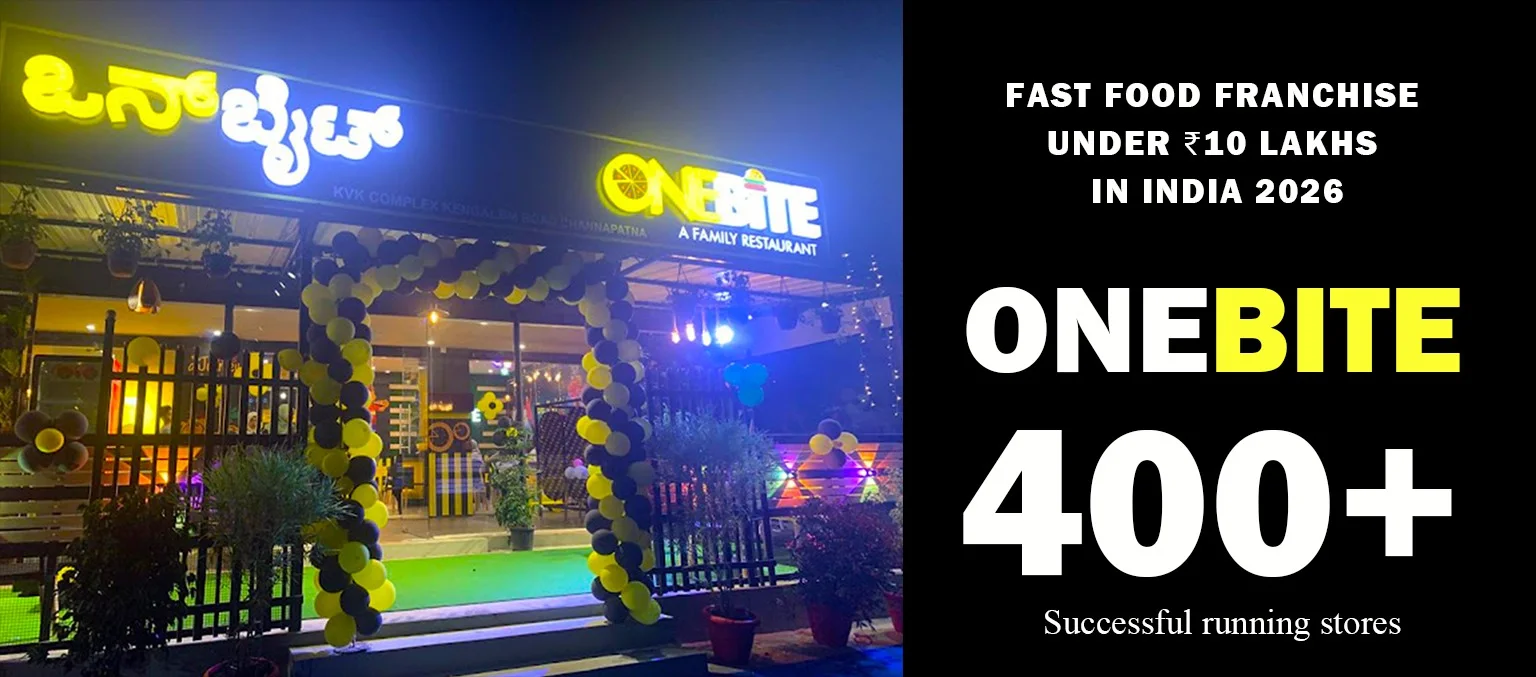
One Bite is a rapidly expanding QSR food franchise with a presence of 400+ outlets spread across 27 states, offering a widely loved menu featuring pizzas, burgers, pastas, wraps, and beverages. Built to deliver strong returns on a modest investment, the model requires a starting outlay of ₹6.99 Lakhs + GST, comes with 0% royalty so franchisees retain 100% of profits, targets net profit margins of 25–35%, and enables full ROI within 12–15 months. Backed by a loyal customer base and comprehensive training support, it makes for a strong choice for aspiring first-time entrepreneurs.
Wow! Momo is one of India's best-known homegrown QSR chains, built entirely around momos, momo-burgers, and Asian street food, with hundreds of outlets nationwide and strong backing from major investors. Historically, the company has largely grown through company-owned stores rather than open franchising, though some listings cite a Lowest Investment starting around ₹8 Lakhs for compact express models up to a Highest Investment of ₹20 Lakhs for standard retail units with a modest franchise fee. Because its franchising policy has shifted over time, interested entrepreneurs should confirm current availability directly with Wow! Momo before assuming a slot exists. Its strong brand recall, delivery-platform tie-ups, and loyal customer base make it an attractive name if franchising opens up.
Chai Sutta Bar (CSB) is Indore-based and one of India's fastest-growing tea café chains, famous for kulhad chai served alongside snacks, now present in 600+ locations across India and abroad. It offers kiosk, medium, and larger café formats, with entry-level kiosk investments featuring a Lowest Investment cited near ₹6 Lakhs, though full-format standard café outlets often carry a Highest Investment running higher (₹20–30 Lakhs) depending on city and format. Profit margins are commonly cited around 35–40%, with payback in roughly a year or more. CSB runs on a FOFO model with royalty fees, strong brand recognition, and rapid national and international expansion, making it a popular pick for aspiring café owners.
Tibbs Frankie capitalizes on India's booming quick-service restaurant market by offering an established, iconic street-food franchise centered on signature rolls and wraps. Tailored for high-footfall areas like malls, college hubs, and transit stations, the brand operates via compact kiosks and express counters requiring minimal space of 75 to 200 sq. ft. With an initial investment range between ₹5 Lakhs and ₹10 Lakhs, capital is utilized for counter setup, essential warming and preparation equipment, point-of-sale systems, and branding. Standardized base-kitchen pre-preparation minimizes food waste and operational complexity, while central supply chain support and food-delivery partnerships drive fast payback cycles and high profit margins.
The Belgian Waffle Xpress (TBWX) capitalizes on the rapid expansion of waffle-focused quick-service restaurants across metro and Tier-2 markets, offering an accessible franchise entry with high profit margins of up to 70%. Designed to run out of small takeaway counters, compact kiosks, or cloud kitchens, the model minimizes overhead through a streamlined menu requiring fast preparation and a lean team of just one to two employees. With total initial setup costs ranging from ₹4 Lakhs to ₹7 Lakhs, the investment covers specialized kitchen machinery like waffle irons and refrigeration, store branding, POS setup, and initial raw material stock, driving strong operational efficiency and a fast path to profitability.
Tea Time is a regional tea-and-snacks café franchise positioned as an affordable entry point into India's booming chai-café segment, similar in spirit to brands like Chai Sutta Bar and Chaayos but smaller in scale. It typically operates through compact kiosk or small-café formats starting at a Lowest Investment of ₹4 Lakhs up to a Highest Investment around ₹8 Lakhs designed to keep setup costs, staffing, and inventory investment low. As beverage-led QSR concepts continue growing rapidly across small and mid-sized Indian cities, tea-focused brands like this benefit from low ingredient costs and high repeat footfall. Because brand size, outlet count, and franchise terms for lesser-known regional players can vary widely, direct verification with the franchisor is essential.
Rolls Nation is a fast-casual brand centered on Indian-style kathi rolls, wraps, and rice bowls, targeting the fast-growing on-the-go street food segment. Its appeal lies in a simple kitchen setup, minimal seating requirements, and quick preparation times, which typically keep total setup costs spanning a Lowest Investment of ₹5 Lakhs to a Highest Investment of ₹10 Lakhs, keeping entry costs relatively low compared to full-service restaurants. Rolls-based QSR concepts have gained traction in India due to strong delivery-platform demand and low per-unit food cost, supporting healthy margins. As with many roll-focused chains, franchise fee, royalty percentage, and total setup cost can vary by city and outlet size, so confirming updated figures with the company directly is recommended.
Roll Xpress follows a similar quick-service model to other roll and wrap brands, offering a compact menu built around kathi rolls, frankies, and rice-based rolls suited to high-footfall areas like markets, colleges, and office hubs. The format typically requires a small kitchen space, limited seating, and lower equipment investment, keeping capital requirements bounded between a Lowest Investment of ₹4.5 Lakhs and a Highest Investment of ₹9 Lakhs to keep entry costs within reach for first-time franchisees. Such brands rely heavily on speed of service and consistent recipe standardization across outlets. Given the number of similarly named roll franchises operating regionally in India, prospective franchisees should confirm the exact brand's registration, outlet performance data, and support systems before investing.
Burger Brothers (also marketed in some regions as Burger Point) is a value-focused burger QSR concept aimed at price-sensitive Indian consumers, competing in the budget burger segment alongside numerous regional chains. These brands typically use small kiosk or cloud-kitchen-style formats with a Lowest Investment starting around ₹5 Lakhs and a Highest Investment up to ₹10 Lakhs to minimize real estate costs, with menus built around affordable burgers, fries, and beverages. Because "Burger Brothers/Point" naming overlaps with several unrelated regional operators across India, franchise terms, outlet counts, and investment figures differ significantly by company. Entrepreneurs should identify the specific legal entity behind any offer, check outlet reviews, and request documented financials before signing a franchise agreement.
Cheese Corner India specializes in cheese-loaded fast food items such as cheese burgers, cheese balls, cheesy rolls, and similar indulgent snacks aimed at younger, urban consumers. The cheese-and-snack QSR niche has grown steadily in India due to rising demand for shareable, photogenic street food, often performing well near colleges, malls, and high-street locations. Typical setups favor small kiosks requiring a Lowest Investment of ₹5 Lakhs up to a Highest Investment of ₹9 Lakhs with limited kitchen equipment, helping keep initial investment lower than full-format restaurants. As with many niche regional snack franchises, exact franchise fees, royalty structure, and outlet support vary, so verifying current terms and brand ownership directly with the company is advisable.
Momo King is a momo-focused QSR brand competing in the same fast-growing dumpling segment as Wow! Momo, offering steamed, fried, and tandoori momo varieties along with dips and sides. Momo-based franchises remain popular low-investment options in India because ingredient costs are low, preparation is fast, and demand spans age groups and cities. Entry-level kiosk setups generally operate within a Lowest Investment of ₹6 Lakhs and a Highest Investment of ₹12 Lakhs needing minimal space and equipment, keeping total investment modest compared to full-service restaurants. Given the number of similarly branded momo franchises across India, prospective franchisees should confirm Momo King's specific legal ownership, outlet track record, and franchise support before committing investment.
Giani's is a long-established Indian dessert and ice cream brand, particularly known in North India for kulfi, falooda, and ice cream since its founding decades ago in Delhi. It has expanded through franchising into parlour and kiosk formats across multiple cities, ranging from a Lowest Investment of ₹9 Lakhs for small counters to a Highest Investment of ₹15 Lakhs or more for full-scale dessert parlours, leveraging strong legacy brand recognition and a loyal customer base built over generations. Dessert franchises like Giani's often benefit from steady year-round demand and relatively simple operations, though exact investment, franchise fee, and royalty terms should be confirmed directly with the company, as they can vary depending on outlet format, location, and whether it's a full parlour or smaller counter setup.
Beyond named brands, generic "momo kiosk" franchise models are widely marketed across India as one of the lowest-investment fast food options, often requiring only a small counter, steamer, and basic seating or takeaway setup. These are popular with first-time entrepreneurs because momos have low ingredient cost, fast preparation, and broad appeal across demographics and cities. Investment for such kiosks features a Lowest Investment of ₹3 Lakhs to a Highest Investment of ₹8 Lakhs as frequently advertised, though quality, training, supply chain support, and brand recognition vary enormously between operators. Because many of these are smaller or less-regulated regional players, thorough due diligence on the specific franchisor is essential before investing.
| Lower Risk | The benefits of investing in a low-cost, profitable food franchise are lower risk of failure and financial losses due to minimal up-front cost. The proven business model of food franchise business also reduces business risk by providing an operational guidance and necessary training for managing business operations and customer services. |
| Faster ROI | The investment in a food franchise business with a low cost of faster Return on Investment (ROI) as the franchisor offers bulk purchasing and a Central distribution process that reduces the cost of ingredients in the business. The established brand recognition, existing customer base, efficient business operations and proven business model ensure faster ROI in the Food franchise business. |
| Brand Recognition | A food franchise business model offers an established brand name and recognition well-recognised among targeted customers in the market, which helps the franchise outlet to gain consistent sales and profitability from business initiation. The brand recognition of the franchisor ensures customer loyalty and competitive advantages in the market for the franchise outlet, leading to growth and success of the business. |
| Extensive Support | Investing in a food franchise business comes with complete support and guidance of the franchisor in the form of ongoing operational guidance and staff training programs that help the franchise outlets to ensure error-free business process and satisfactory customer services. Franchise business models also offer scalability and market expertise, leading to better chances of financial growth and profitability for the business in the long-run. |
| High Customer Repeat Rate | Because the food is priced for everyday eating, you don’t have to wait for holidays; customers will visit you several times a week. |
| Easier Expansion | Once your first small shop is running well, it’s much easier to save up and open a second outlet in another part of town. |
Getting started isn't as complicated as it seems if you have a brand to guide you. It saves you the headache of creating recipes from scratch or trying to build a name on your own.
The secret to these businesses is keeping your "fixed costs" low. When you aren't paying a massive rent for a huge hall, your profit grows much faster.
Franchise businesses may face too much competition at the internal and external level, which can be addressed by focusing on the individual unique selling proposition and understanding the specific demands of the target market. By providing innovative and exceptional Customer service, franchise outlets can efficiently address the significant challenge of too much competition.
Managing the high running cost of a franchise outlet can be a significant challenge for businesses. To manage the running cost of a franchise, individuals should focus on optimising overall business operations and implement cost-effective measures to streamline the processes. Franchisees should also negotiate for better supplier deals and monitor employee turnover actively.
Keeping customers happy in a franchise business is essential to maintain the brand image and ensure sales and profitability for the longer term in the market. Franchise outlets should ask for feedback constantly to foster customer loyalty and offer personalization to manage a unique brand image among the targeted segment. Franchises should have access to customer service training from the franchisor to deliver and maintain loyalty of consumers.
Franchises should analyse their customer bases to enhance the effectiveness of their marketing strategies through traditional and digital marketing techniques to actively engage the targeted population. Franchisees can also review and improve pricing and product offerings to the existing and potential consumer base in association with the franchisor to improve sales and profitability of the business.
One Bite has become a favorite because it offers a "shortcut" to success for people who are new to the food business. It’s simple, affordable, and very effective.
The legal requirements to start a food franchise in India include necessary licenses and permits, including trade license, eating house license, FSSAI license, MOA, AOA, franchise agreement, etc.
Yes, franchisors play an important role in the marketing and branding practices of franchise outlets by providing necessary resources and guidelines to maintain brand consistency and profits.
Yes, franchise outlets can easily create partnerships with food delivery applications like Swiggy and Zomato to reach a wider audience and maintain high sales and profitability.
To ensure the success of a food franchise business, it is important to maintain consistent brand standards, effective marketing processes, customer-focused services and operational efficiency.
No, franchises are not allowed to change the pricing of menu items, however, in some cases, the franchisor allows them to modify the prices of the menu to serve a specific population at a particular location.
You should follow the brand's guidelines; for One Bite, you need roughly 100-150 sq. ft. Just make sure there is enough room for a kitchen counter, a billing area, and basic plumbing.
Absolutely. In fact, these cities often see better profits because the rent is much lower and people are always excited to have a quality brand open in their neighborhood
To conclude, there are several fast food franchise options available for interested investors under ₹10 lakhs of investment in India. Before selecting one of the most profitable food franchises under ₹10 lakhs, individuals should consider brand strength, business model, available support, franchise agreement, etc. Individuals can select one of the most profitable food franchises in India, such as One Bite, Frozen Bottle, Subway, etc. The investment in a low-cost, profitable food franchise offers low risk, strong brand recognition, extensive support and faster ROI. Individuals may also face some challenges in establishing a franchise business and need to address them properly.
Take your first step towards a profitable food franchise business.
Your franchise enquiry has been successfully submitted. Our team will get in touch with you shortly.